
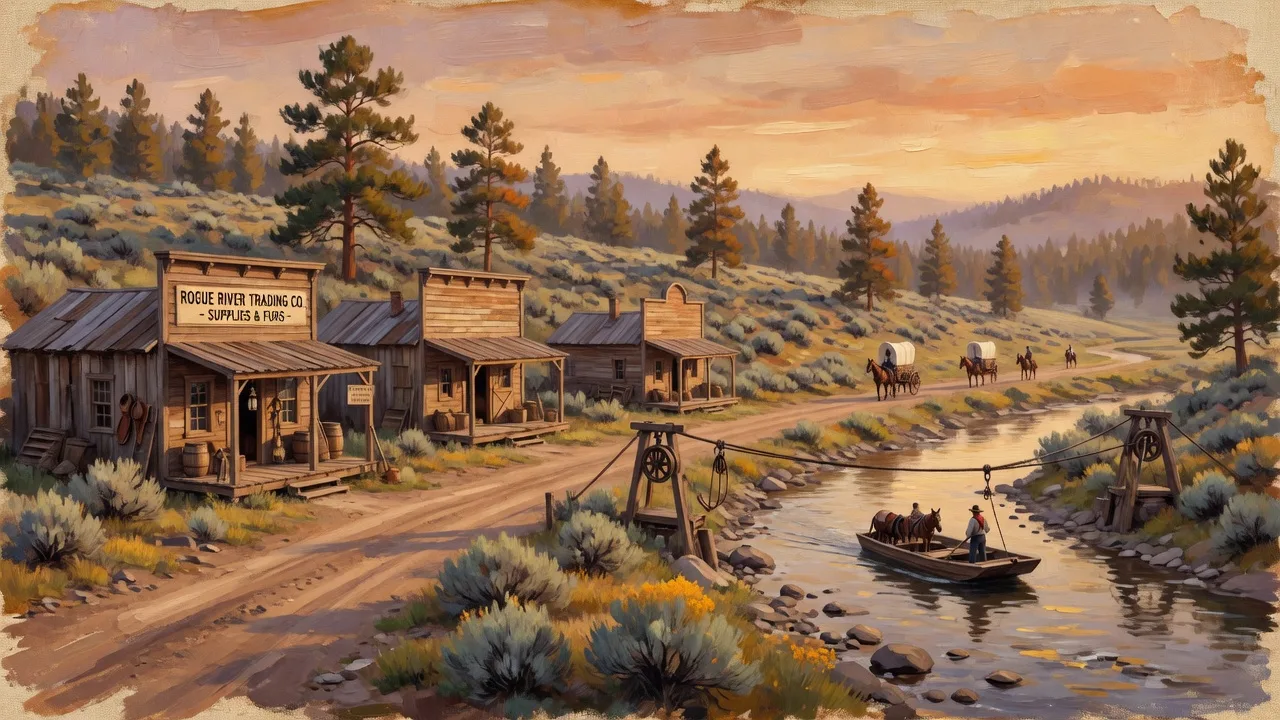
Imagine arriving in Southern Oregon during the 1870s and asking someone for directions to Klamath Falls.
You might have received a confused look.
Not because the community did not exist, but because the name had not yet been adopted.
The place you were looking for was Linkville.
That earlier name belongs to a fascinating period when the future city was little more than a developing settlement beside an important river crossing.
The Beginning of Linkville
George Nurse established a trading location and ferry operation along the Link River in 1867.
The surrounding region was sparsely populated by Euro-American settlers, although Indigenous communities had occupied and traveled through the basin for thousands of years.
The ferry served an important transportation function.
Crossing rivers could be difficult, particularly when travelers were moving livestock, supplies or wagons.
A reliable crossing made the location useful.
And useful locations often became towns.
What Was Life Like in Early Linkville?
Life in the developing settlement would have been very different from life in modern Klamath Falls.
There were no paved highways carrying vehicles toward Bend or California. No large supermarkets. No airport connecting the region with distant destinations.
Residents relied on local commerce, agriculture, ranching, personal relationships and transportation systems that were frequently slow and vulnerable to weather.
In 1872, Linkville reportedly had only about forty residents.
That is smaller than many modern neighborhood gatherings.
Yet the community was growing.
A sawmill was established in 1877, reflecting the economic importance of surrounding forests.
Businesses appeared to serve ranchers, travelers and residents.
The community developed institutions and commercial relationships that made it increasingly important to the surrounding countryside.
Becoming the County Seat
In 1882, Klamath County was created from the western portion of Lake County.
Linkville became its county seat.
This decision was a major turning point.
A county seat becomes a destination for government business, legal proceedings, records and public services.
People who might otherwise have had little reason to visit a small settlement now needed to travel there.
That increased demand for lodging, supplies, professional services and commerce.
The county-seat designation helped Linkville establish the regional importance that Klamath Falls still enjoys today.
The Fire That Tested the Town
In 1889, a major fire destroyed much of Linkville's business district.
For a small frontier community, such destruction could have threatened its future.
Buildings represented substantial investments, and rebuilding required materials, labor and confidence that the town would continue to grow.
Linkville rebuilt.
The recovery reflected the determination of residents and the economic importance of the location.
It also preceded a period of transformation that would eventually include incorporation, railroad construction and major industrial expansion.
Goodbye Linkville, Hello Klamath Falls
In 1893, the community changed its name to Klamath Falls.
The new name referred to the historic rapids and falls along the Link River.
The settlement incorporated as a city in 1905.
Within only a few years, federal irrigation development and the arrival of Southern Pacific would dramatically expand its economic opportunities.
The little river-crossing community had become the foundation of a much larger city.
Finding Linkville in Today's Klamath Falls
The name Linkville may have disappeared from official city maps, but the history remains.
The Link River still connects Upper Klamath Lake and Lake Ewauna.
Historic maps and archival newspapers preserve the old town name.
Museums maintain photographs and documents from the settlement period.
And downtown Klamath Falls still occupies the general urban landscape that developed from those early beginnings.
For people who enjoy historic neighborhoods, old buildings and communities with a strong sense of place, learning about Linkville adds another layer of meaning to a walk through town.
The streets may have changed, but the geography that brought people here remains recognizable.
Frequently Asked Questions
What was Klamath Falls called before 1893?
Linkville.
Who established the settlement?
George Nurse established an outpost and ferry operation in 1867.
Was Linkville a large town?
No. It remained quite small during its earliest years, with approximately forty residents reported in 1872.
Why did Linkville become important?
Its river crossing, trading activity and designation as Klamath County's seat helped establish its regional role.
Explore More
Sources and Further Reading
- Oregon Encyclopedia: Klamath Falls (city)
- Oregon Encyclopedia: Linkville and the Moore Family
- Oregon Historical Society
- Klamath County Museums
- Historic Oregon Newspapers
Historical claims in this article trace to the authoritative sources listed above. Illustrations are labeled as such and are not archival photographs.