
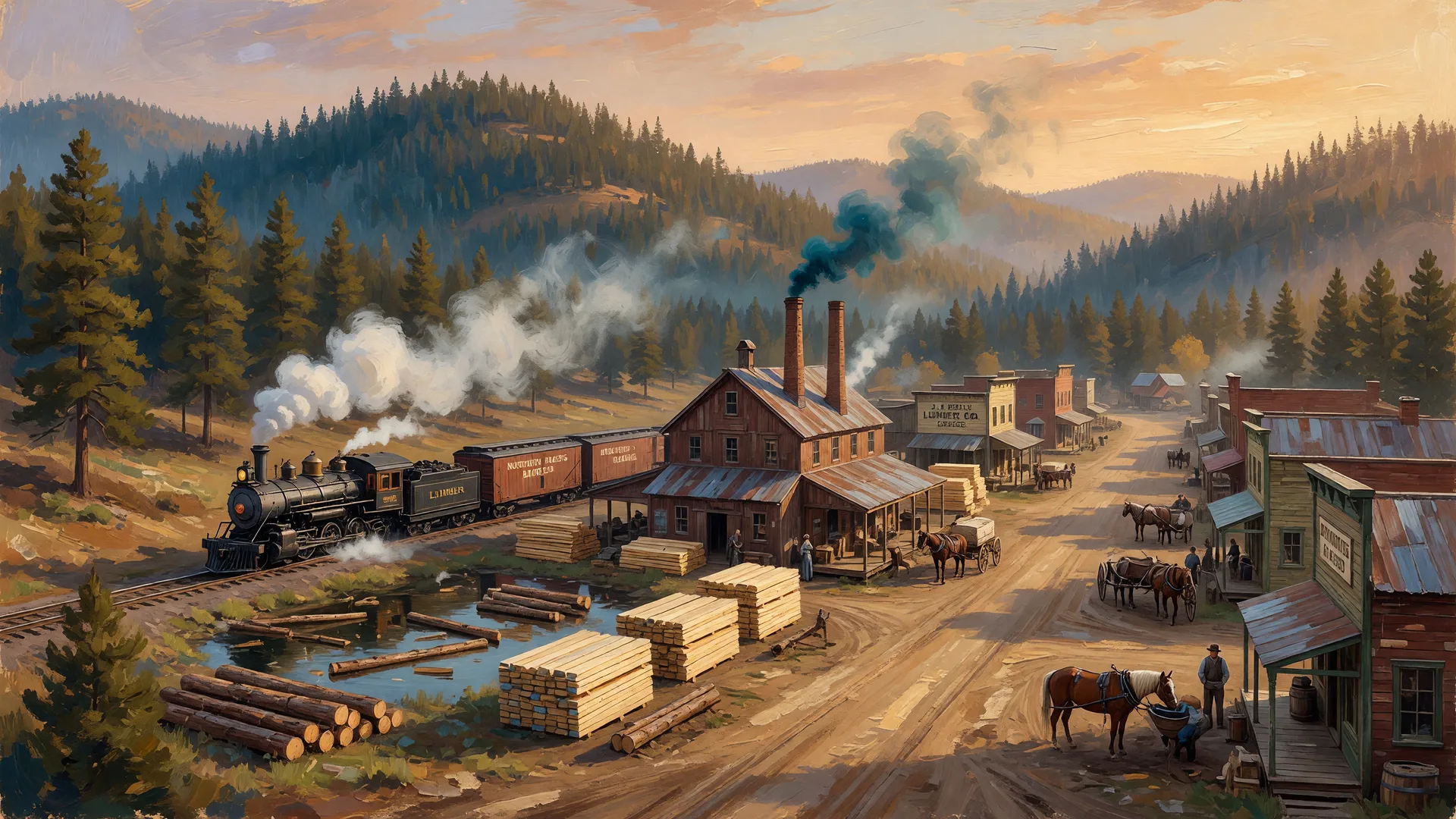
Every city has a reason for existing.
Sometimes it is a harbor. Sometimes it is a mining discovery, a railroad junction or a crossroads.
For Klamath Falls, the answer involves several forces working together over more than a century.
A useful river crossing helped create the original settlement. County government made it an administrative center. Agriculture brought economic activity. The railroad opened distant markets. Timber attracted workers and investment.
Eventually, schools, hospitals, businesses and public institutions gave the community a permanence that extended beyond any single industry.
Geography Created the Opportunity
The Link River connects Upper Klamath Lake and Lake Ewauna.
For early travelers, a crossing near that river could be strategically important.
When George Nurse established his ferry and trading outpost in 1867, he created a place where transportation and commerce could meet.
Small settlements often grew around precisely these kinds of practical necessities.
Travelers needed food, supplies and lodging.
Ranchers needed commercial connections.
Residents needed access to goods that were not produced locally.
The community of Linkville gradually emerged.
Government Strengthened the Town
In 1882, Linkville became the seat of newly created Klamath County.
This changed its economic prospects.
County government brought people into town for public business.
Professional services developed around legal, financial and administrative needs.
Businesses benefited from visitors arriving from surrounding rural communities.
Over time, the settlement became more than a transportation stop.
It became a place people depended on.
Agriculture Created Regional Commerce
Ranching was important during the nineteenth century, and agriculture expanded as irrigation infrastructure developed.
The federal Klamath Project became a major influence during the early twentieth century.
Water delivery systems supported agricultural expansion, while the associated drainage and land-conversion projects transformed portions of the basin.
Farms required equipment, seed, supplies, financing, transportation and processing services.
Klamath Falls benefited from serving those needs.
Even people who did not work directly in agriculture were connected to the agricultural economy through commerce and employment.
The Railroad Accelerated Everything
Southern Pacific arrived in 1909.
For Klamath Falls, the railroad was more than a transportation improvement.
It changed the scale of what businesses could accomplish.
Heavy equipment could arrive more efficiently.
Agricultural products could reach larger markets.
Timber companies could ship lumber economically.
Travel became more practical.
New businesses opened, construction increased and the city grew rapidly.
The railroad helped transform a remote community into a significant regional industrial center.
Timber Creates Jobs and Neighborhoods
The surrounding forests contained valuable ponderosa pine.
Rail access helped support large-scale timber production.
Sawmills and box factories became major employers, attracting workers and their families.
The economic impact extended far beyond mill gates.
Workers needed homes.
Families needed schools.
Residents shopped downtown, attended local events and supported community organizations.
Neighborhoods expanded because industries created reasons for people to remain in the community.
This is an important connection for anyone exploring older residential areas today.
Many neighborhoods developed during periods when timber, rail transportation and related businesses were expanding.
Downtown Becomes the Community Center
As the population and economy grew, downtown Klamath Falls developed into a center for shopping, professional services, entertainment and civic activity.
Hotels accommodated travelers.
Banks financed businesses and property.
Theaters offered entertainment.
Government buildings represented the city's expanding public institutions.
Historic architecture from these periods survives in portions of downtown.
The buildings are reminders that Klamath Falls once served as a bustling commercial destination for people traveling from communities throughout the basin.
Education and Health Care Strengthen the City
Over time, the local economy diversified.
Educational institutions became increasingly important, including Oregon Institute of Technology.
Health care expanded into a significant regional service sector.
Government, professional services, retail and tourism contributed additional employment.
These developments helped Klamath Falls maintain its role as a regional center even as the timber economy changed.
The community was no longer dependent on precisely the same combination of industries that had driven its early growth.
A Community Shaped by Reinvention
Klamath Falls has experienced economic booms, difficult transitions and changing industries.
That pattern is common in Western resource communities.
What makes its story interesting is how clearly those changes remain visible.
Historic commercial buildings recall the railroad and timber years.
Agricultural canals reveal the influence of reclamation.
Older neighborhoods reflect different periods of residential growth.
Modern educational and medical facilities represent newer economic priorities.
The city is not frozen in any one era.
It continues to adapt.
What This Means for Someone Moving Here
Understanding growth patterns can help prospective residents make sense of Klamath Falls.
An established neighborhood near downtown may offer older architecture and proximity to historic amenities.
Other residential areas may have different lot sizes, housing styles and development histories.
Rural communities outside the city can provide agricultural surroundings, acreage or greater separation from urban activity, but may require additional attention to utilities, roads and property maintenance.
No single neighborhood represents the entire Klamath Falls experience.
The community's history created a variety of living environments, each with different advantages and practical considerations.
Frequently Asked Questions
Why did Klamath Falls become an important Southern Oregon city?
Its transportation location, county-seat status, agricultural economy, railroad access and timber industry helped establish its regional importance.
When did the railroad arrive?
Southern Pacific reached Klamath Falls in 1909.
Was Klamath Falls primarily a timber town?
Timber was a major historical industry, but agriculture, transportation, commerce, government and other services also contributed to growth.
What supports the modern economy?
The regional economy includes health care, education, government, agriculture, commerce, tourism and other industries.
Explore More
Sources and Further Reading
- Oregon Encyclopedia: Klamath Falls (city)
- Klamath County Museums
- Oregon Historical Society
- Bureau of Reclamation: Klamath Project
- Oregon Institute of Technology
Historical claims in this article trace to the authoritative sources listed above. Illustrations are labeled as such and are not archival photographs.