
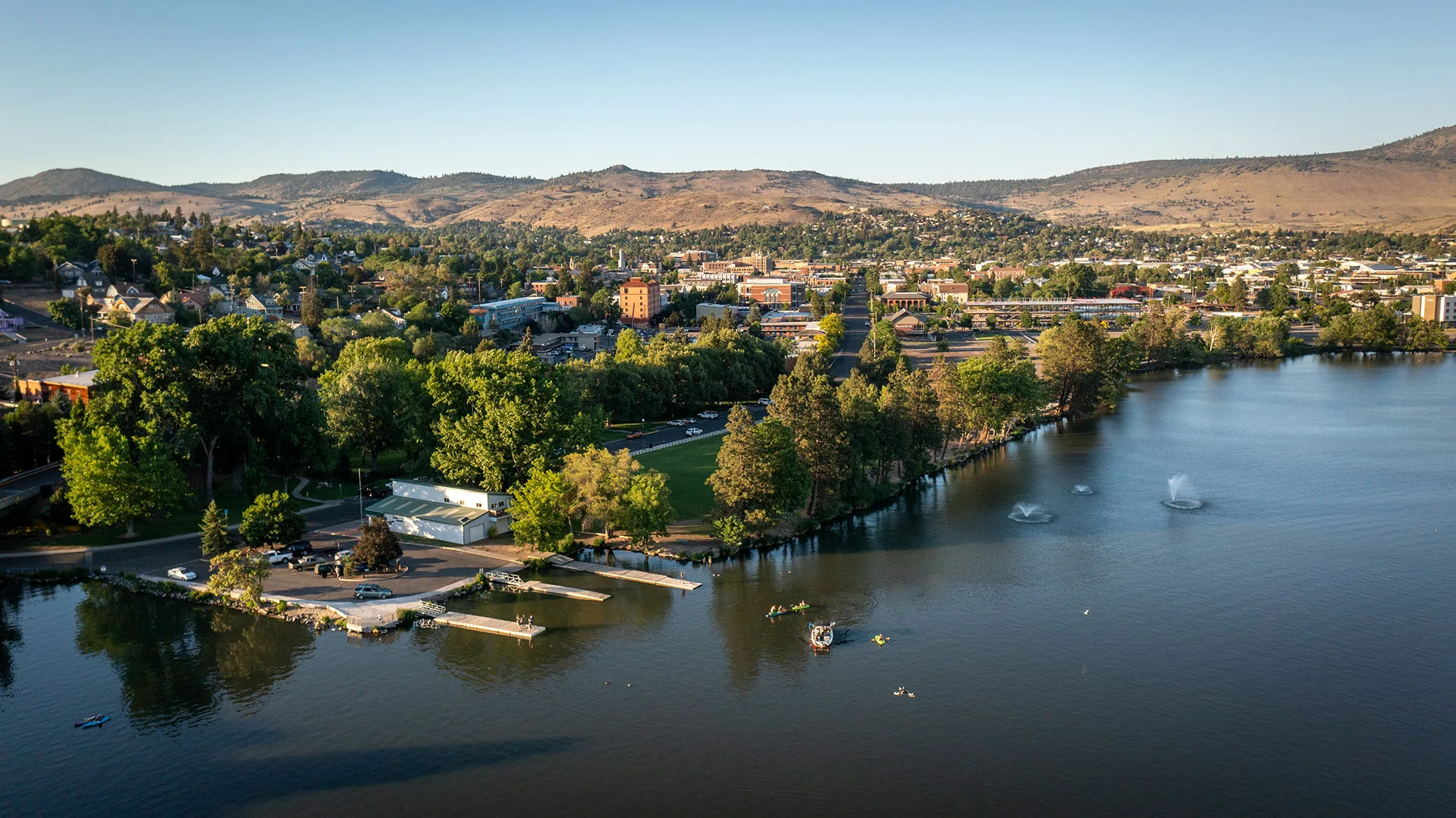
When the War Ended, Klamath Falls Entered a New Era
The end of World War II brought celebrations across America, but it also brought a period of enormous adjustment.
Millions of servicemen and women were returning home. Families who had postponed marriage, homeownership, and other major decisions during the war began planning their futures.
Industries that had served military needs had to adapt to civilian demand. Communities faced questions about employment, education, housing, and how to accommodate a generation eager to build new lives.
Klamath Falls experienced these changes in ways shaped by its particular economy and geography.
The city had an established lumber industry, an agricultural region transformed by federal reclamation, railroad connections, and wartime military installations.
After 1945, those elements interacted with returning veterans, housing demand, educational development, and new expectations about family life.
The result was a period of change that continues to influence the city’s buildings, institutions, and neighborhoods.
Returning Veterans and the Search for Opportunity
The return of military personnel created both opportunities and challenges.
Veterans needed employment, housing, education, and ways to transition from military to civilian life.
The federal Servicemen’s Readjustment Act of 1944, widely known as the GI Bill, helped eligible veterans pursue education and obtain certain housing and business benefits.
Those programs influenced communities throughout the United States, including Oregon.
For a returning veteran, the possibility of training for a career or purchasing a home could fundamentally change the family’s future.
But benefits did not automatically produce equal opportunities for everyone. Historically, discrimination and unequal access to lending, education, and housing limited the practical benefits available to some veterans and families.
Understanding the postwar era requires recognizing both its possibilities and its inequalities.
A Remarkable Transition: Military Buildings Become a School
One of Klamath Falls’ clearest postwar transformations occurred at the former Marine Barracks.
During World War II, the installation treated Marines recovering from tropical illnesses.
After its closure in 1946, the property became available for civilian reuse.
In 1947, the former military installation became the original home of the Oregon Vocational School, a predecessor of Oregon Institute of Technology.
This was more than a change in the name on a building.
It reflected a national need for technical education and skilled workers.
A community that had supported wartime military operations was now helping prepare people for civilian careers.
The institution would eventually become an important part of Klamath Falls’ identity, connecting education, technology, employment, and regional development.
For a city whose economy had long been closely associated with timber and agriculture, technical education offered another avenue for opportunity.
The Postwar Housing Boom
Across the United States, the years following World War II brought significant demand for housing.
Returning veterans, young families, population changes, and federal mortgage programs helped reshape the housing market.
Builders responded with practical homes designed for everyday family life.
Nationally, common postwar designs included compact ranch homes, simple cottages, and houses with efficient floor plans and fewer ornamental details than many earlier architectural styles.
These trends are useful when examining older residential neighborhoods in Klamath Falls, although individual properties must be dated and evaluated separately rather than assumed to belong to a particular period.
The housing boom also changed what Americans expected from their homes.
Garages became increasingly important as automobile ownership expanded.
Living rooms, kitchens, and family spaces reflected changing domestic routines.
Residential development increasingly accommodated driving and off-street parking.
The postwar house was not simply a place to live. It reflected a changing relationship between work, transportation, family, and community.
The Importance of Timber to Postwar Construction
Klamath Falls occupied an interesting position in the postwar housing economy.
Across the country, families needed lumber to build homes.
Southern Oregon had extensive timber resources and an established milling industry.
At first glance, that might suggest an uncomplicated period of prosperity.
But the actual history was more complex.
The Oregon Historical Society documents that several older Klamath Falls mills closed during the 1940s and 1950s, even as postwar construction created strong demand for lumber nationally.
The Pelican Bay Lumber Company, Lamm Lumber Company, and Shaw-Bertram Lumber Company were among the operations identified in the region’s industrial transition.
This illustrates an important distinction: strong national demand does not guarantee that every local employer will thrive.
Changes in timber availability, business structures, technology, transportation, costs, and competition can reshape an industry even during a broader boom.
For local workers, these transitions affected family finances and the stability of neighborhoods dependent on mill employment.
Agriculture, Veterans, and the Klamath Reclamation Project
The postwar years also changed rural parts of the Klamath Basin.
The federal reclamation system had already transformed portions of the region through irrigation development.
After World War II, veteran homesteading programs offered eligible veterans opportunities to establish agricultural operations on certain reclamation lands.
One especially revealing account preserved by the Oregon Historical Society describes Eleanor Bolesta, who became the first woman to win a Bureau of Reclamation homestead through the veterans’ lottery.
Her husband, a Marine wounded on Guam, sought a drier climate while recovering.
Their story connects military service, health, federal land policy, agriculture, and family determination.
It also reveals the improvisation involved in establishing a new life.
The family used materials from former wartime barracks buildings to help create housing on their homestead.
A structure associated with confinement and war could be dismantled and reused as part of a family’s new home.
The history is complicated and deserves careful treatment, especially because some of those materials came from the former Japanese American incarceration camp.
That fact should not be separated from the broader history of wartime incarceration and the people who had been forcibly confined there.
Read the Oregon Historical Society’s account
Cars, Roads, and the Changing Shape of Daily Life
The postwar era accelerated changes in American transportation.
Automobile ownership became more central to family life, influencing the design of houses, commercial districts, and streets.
In established communities, older pedestrian-oriented neighborhoods coexisted with newer development that provided garages, driveways, and more space for vehicles.
Klamath Falls’ topography created additional considerations.
Hillsides, lakefront areas, railroad corridors, industrial land, and the existing street network affected where new housing could be constructed.
Unlike a city built entirely on flat ground, Klamath Falls developed around physical features that could make nearby neighborhoods feel quite different.
A hillside home might offer views but require steep access.
A lower-elevation property might provide a more level yard while presenting different drainage or site considerations.
Those geographic differences continue to matter to homeowners today.
Schools, Families, and Community Institutions
Postwar population changes and family formation affected community institutions across the country.
Schools, recreational facilities, churches, service organizations, and neighborhood businesses became important gathering places for growing families.
In Klamath Falls, education gained particular significance through the creation and expansion of technical training.
Local schools and community organizations also formed part of the social infrastructure that supported families through economic changes.
Historic school buildings and older neighborhoods can offer clues about how communities organized daily life before today’s patterns of shopping, commuting, and digital communication.
But the development of any particular school or neighborhood should be researched through local records rather than assigned an unsupported construction date.
The Postwar Years Were Not Equally Prosperous for Everyone
The phrase postwar boom can suggest that everyone benefited in the same way.
That was not the case.
Some households gained access to homeownership and education.
Others faced employment instability, discriminatory lending practices, or barriers to opportunity.
Agricultural settlement also occurred within a much longer history of Indigenous dispossession, federal reclamation policy, and major environmental changes to the Klamath Basin.
For the Klamath Tribes and other Indigenous communities, the twentieth century included profound disruptions to land, resources, and sovereignty.
The federal termination of the Klamath Tribes in 1954 became another defining event of the postwar period, with consequences extending far beyond the 1950s.
A complete history of Klamath Falls cannot treat postwar growth solely as a story of new homes and expanding opportunity.
It must also recognize who benefited, who faced barriers, and whose communities experienced loss.
What Postwar Homes Tell Us Today
Many homebuyers are attracted to mid-century properties because of their proportions, established surroundings, and practical layouts.
Depending on the house, features may include single-level living, original woodwork, mature landscaping, generous windows, or attached garages.
But an older home deserves careful evaluation.
A buyer should investigate the roof, foundation, electrical system, plumbing, insulation, windows, drainage, heating, and any additions or alterations.
The presence of original features can be appealing, but age alone does not establish historic significance or guarantee construction quality.
Homes from this period may also contain materials that require special care during renovation, including asbestos-containing products or lead-based paint.
Qualified inspectors and appropriate specialists can help buyers understand property-specific conditions.
Living in a City Shaped by Its Past
One of the appealing aspects of Klamath Falls is that different periods of development remain visible.
The historic downtown reflects an earlier commercial era.
Older residential streets reveal different building traditions.
Mid-century homes speak to postwar family life.
Educational institutions, industrial properties, and former military sites reveal how the city responded to changing economic needs.
For someone relocating to Southern Oregon, understanding those layers can make the home search more meaningful.
A buyer may prefer an older neighborhood with established streets, a newer development with different amenities, or rural property outside the city.
Lincoln Home can help prospective residents compare properties based on their actual needs while providing resources that explain the region’s history and development.
Frequently Asked Questions
How did World War II change Klamath Falls?
The war brought military installations, personnel, and economic activity. Afterward, returning veterans, housing demand, agricultural settlement, and technical education contributed to the city’s transition.
What happened to the Marine Barracks after the war?
The former installation became the original home of the Oregon Vocational School, which developed into Oregon Institute of Technology.
Did Klamath Falls experience a postwar housing boom?
The community participated in broader postwar housing and economic changes. Specific neighborhood construction patterns and growth rates should be verified through local planning, census, and property records.
Why was timber important after World War II?
Timber supplied construction and other industries, but individual mills faced changing business conditions. Some Klamath Falls mills closed during the 1940s and 1950s despite strong national building demand.
What should buyers know about mid-century homes in Klamath Falls?
Buyers should evaluate the condition of major systems, previous renovations, insulation, drainage, foundations, and potential hazardous materials. A qualified home inspection is particularly important.
Where can I learn more about postwar Klamath history?
The Oregon Historical Society, Klamath County Museum, Klamath County Historical Society, historic newspaper archives, and local government records are valuable starting points.
Continue Exploring
- The History of the Marine Barracks in Klamath Falls (Article 017)
- The Rise and Decline of Klamath’s Timber Economy (Article 019)
- Historic Residential Architecture in Klamath Falls (Article 020)
- How Klamath Falls Neighborhoods Developed (Article 021)
- Home Inspection Guidance for Buyers
- Tribal Communities of the Klamath Basin
- Klamath Falls Relocation Guide
Explore homes for sale in Klamath Falls
Ready to see what today's market offers? Lincoln Home provides live access to current MLS listings across Klamath Falls, Klamath County and Southern Oregon, plus personalized search assistance from a local team.
Availability changes as homes sell and new properties come to market, so search filters and results reflect the live listing feed rather than a fixed inventory.
Research and Sources
- Oregon Historical Society — Klamath Falls, 1941
- Oregon Historical Society — Veterans Lottery and the CCC
- Oregon Historical Society — Transition in the 1950s
- Oregon Historical Society — World War II Opens New Doors
Historical claims in this article trace to the authoritative sources listed above. Illustrations are labeled as such and are not archival photographs; no historic date, designation, quotation or property characteristic is stated beyond what the listed sources support.