
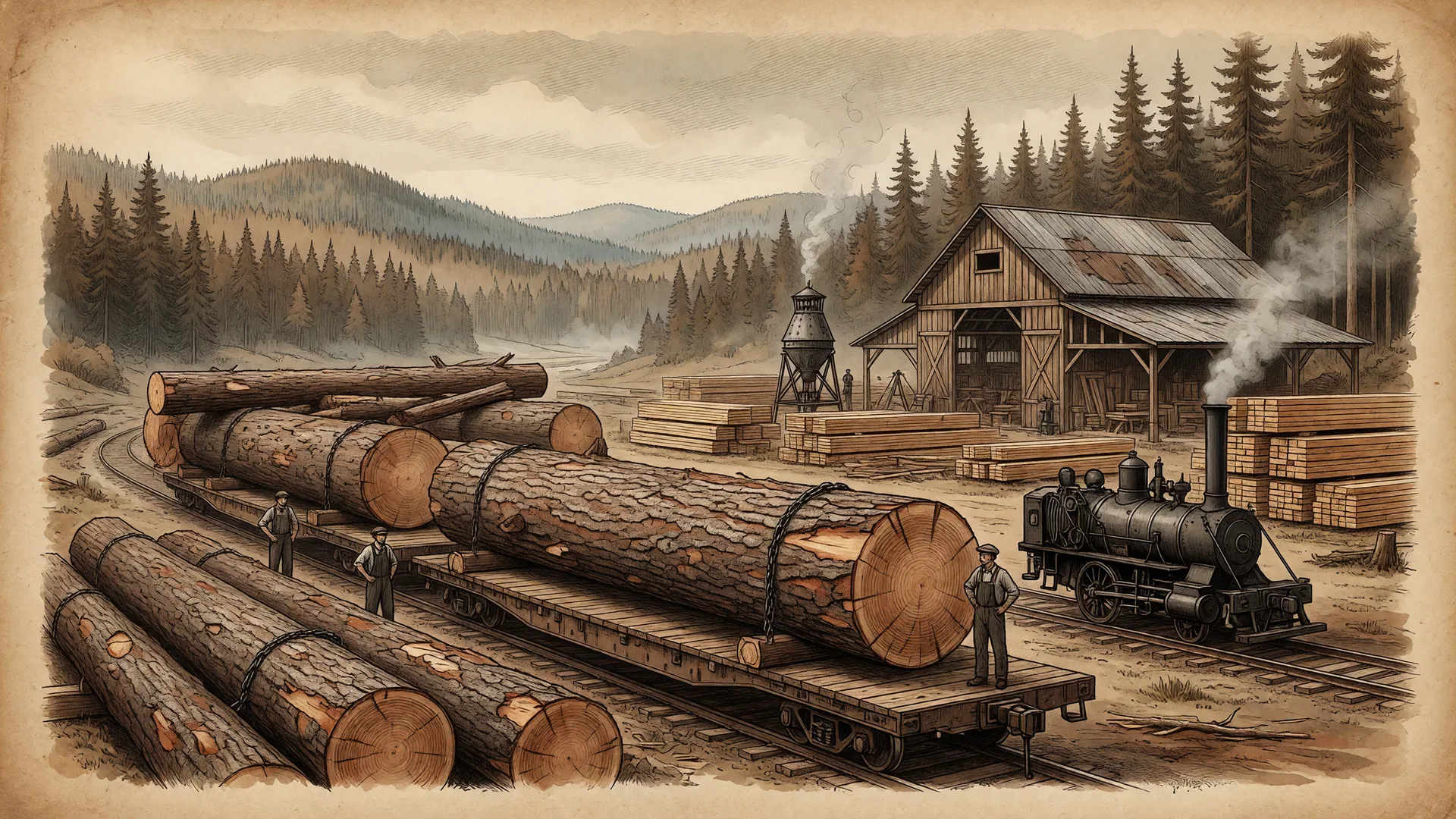
For much of the twentieth century, the sound of sawmills was part of everyday life in Klamath Falls.
Timber trucks, railroad freight cars, lumber yards and mill workers were familiar features of the community.
Families depended on timber paychecks. Businesses depended on timber workers as customers. Neighborhoods grew as the industry expanded.
The timber economy was not simply one business sector among many.
It helped shape the identity of Klamath Falls.
Why the Forests Mattered
The mountains and plateaus surrounding the Klamath Basin contain extensive forestlands.
Ponderosa pine was particularly important to the historical lumber economy.
Its wood was useful for construction and manufacturing, including wooden boxes and other products.
But having trees was not enough.
Commercial logging required equipment, workers, transportation and markets.
Before efficient rail connections, moving lumber out of the region was difficult.
The Railroad Opens the Forest Economy
Southern Pacific reached Klamath Falls in 1909.
That connection changed the economics of timber production.
Lumber could now reach distant customers at a scale that had previously been impractical.
Companies invested in mills and supporting infrastructure.
Logging operations expanded.
Workers arrived from other communities, bringing families and creating demand for housing and services.
The timber industry became an engine of regional growth.
Sawmills and Box Factories
Sawmills processed logs into lumber.
Box factories manufactured wooden containers used to transport agricultural products and other goods.
The Ewauna Box Company became one of the significant operations associated with Klamath Falls' industrial history.
Wooden shipping containers were particularly important before cardboard and other packaging materials became dominant.
The lumber economy therefore connected Klamath Falls with agricultural markets beyond Oregon.
Weyerhaeuser and Industrial Expansion
In 1929, Weyerhaeuser opened a major sawmill in Klamath Falls.
The operation reinforced the city's importance as a timber-processing center.
Large mills required substantial investment and workforces.
They also depended on transportation networks, equipment maintenance, administration and supporting businesses.
The economic impact extended beyond the people working directly inside the mill.
What Was Life Like for Timber Families?
Mill and logging work could be physically demanding and dangerous.
Workers handled heavy equipment, sharp tools and large quantities of timber.
Logging operations took place in forests where weather, terrain and machinery created additional hazards.
Families often organized their lives around work schedules and seasonal conditions.
Local stores, schools, churches and civic organizations served households whose livelihoods depended on the industry.
For many residents, timber employment was not an abstract economic statistic.
It was the reason their parents or grandparents moved to Klamath Falls.
The Industry Changes
Timber production evolved through mechanization, market changes, forest-management policies, environmental regulation and shifts in demand.
Employment declined from historic levels.
Some mills closed or changed operations.
Communities that had depended heavily on timber faced difficult transitions.
These changes affected families, businesses and local government revenues.
They also encouraged economic diversification.
Health care, education, government services, tourism and other sectors became increasingly important.
The Environmental Side of Timber History
Logging history includes complicated environmental questions.
Forest management can influence habitat, erosion, water quality and wildfire behavior.
Different management practices have produced different ecological and economic outcomes.
Today, conversations about sustainable forestry, restoration, wildfire resilience and habitat protection remain important throughout Southern Oregon.
A complete account of the timber industry should acknowledge both the economic contributions of forestry and the environmental consequences of historical practices.
Timber History and Today's Homeowners
Forested property can be beautiful, but ownership involves responsibilities.
Trees near structures may require management.
Defensible space, access for emergency vehicles, insurance availability and local wildfire conditions deserve attention.
Buyers should also investigate whether a parcel is subject to special forestland regulations or restrictions.
A property marketed as timberland may have different practical and legal considerations from a conventional residential lot.
Understanding the region's forestry history is a useful starting point, but current land-use and wildfire requirements must always be verified.
Frequently Asked Questions
Why was timber important to Klamath Falls?
The surrounding forests and railroad access supported large-scale lumber production and related employment.
When did Weyerhaeuser open its Klamath Falls mill?
1929.
What products were made from local timber?
Lumber, wooden boxes and other wood products.
Is timber still part of the regional economy?
Yes, although the industry and its employment levels have changed substantially from historic periods.
Explore More
Explore Lincoln Home's Wildfire Preparedness guide, Rural Acreage and the History of Klamath Falls. For buyers considering wooded land, review current zoning, access, insurance and vegetation-management requirements before making an offer.
Sources and Further Reading
- Oregon Encyclopedia
- Oregon Historical Society
- Klamath County Museums
- Oregon Department of Forestry
- Oregon Historical Society Research Library (lumber collections)
Historical claims in this article trace to the authoritative sources listed above. Illustrations are labeled as such and are not archival photographs.