
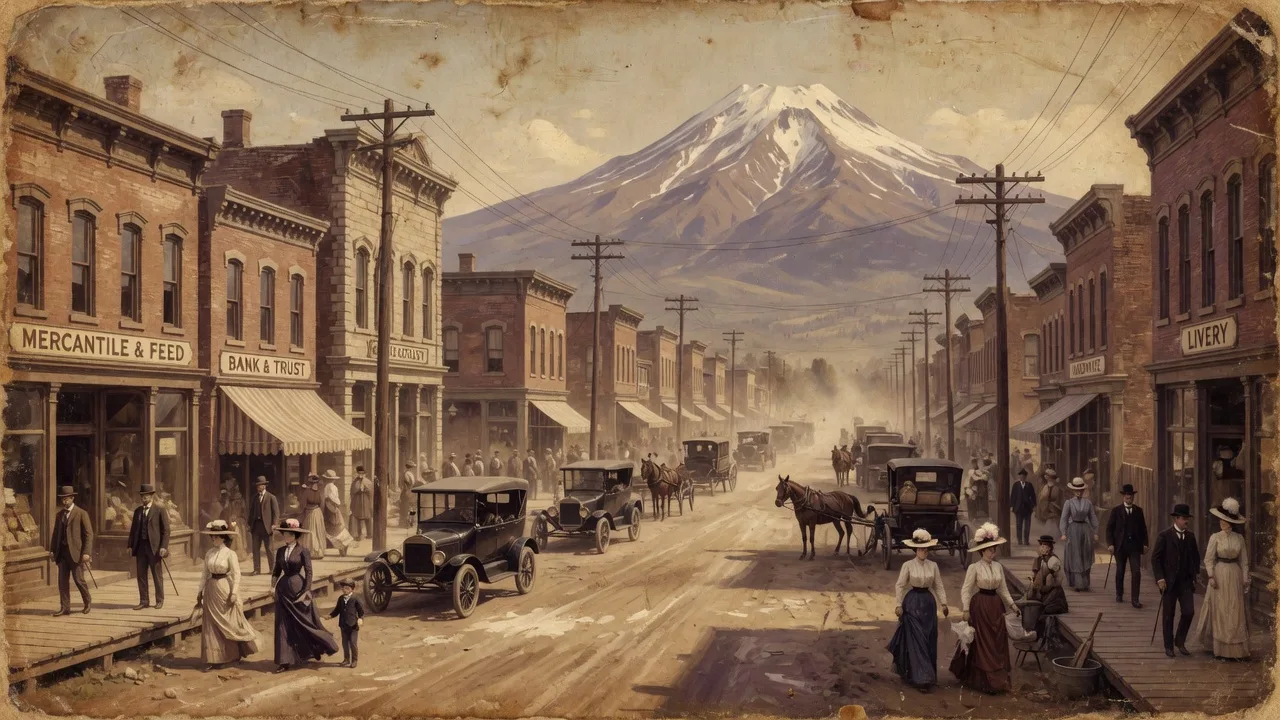
Downtown Klamath Falls is best appreciated slowly.
It is tempting to drive through, notice a few older buildings and continue toward the next destination.
But walking the streets reveals details that are easy to miss from a car: brickwork, decorative façades, historic windows, old commercial entrances and architectural features that reflect the city's early twentieth-century prosperity.
Downtown is not simply where businesses happened to gather.
It is where the community's growth became visible.
From Linkville to a Commercial Center
The original settlement developed near the Link River.
As Linkville grew, businesses appeared to serve ranchers, travelers and residents.
Becoming the county seat in 1882 increased demand for commercial and professional services.
The town also faced setbacks.
A major fire in 1889 destroyed much of the business district, requiring rebuilding.
That experience became part of the city's architectural history.
The Railroad Era
Southern Pacific reached Klamath Falls in 1909.
The resulting economic expansion created demand for hotels, stores, offices, banks and other commercial buildings.
Timber production increased.
Agriculture expanded.
More workers and families moved into the region.
Downtown became the place where these different economic activities met.
Hotels and Travelers
Historic hotels played an important role in downtown life.
Travelers needed places to stay while conducting business, visiting family or passing through the region.
The Baldwin Hotel is among the city's recognizable historic landmarks.
Its survival provides an opportunity to understand how accommodations and commercial life developed during an earlier period.
Historic hotel buildings often reveal details about travel before automobile-oriented motels became widespread.
Civic Architecture
Public buildings also reflected the city's growing ambitions.
Klamath Falls City Hall was constructed in 1914.
Such investments demonstrated confidence that the community would continue growing.
Government buildings, banks and other substantial structures gave downtown a more permanent appearance.
Architecture became a visible expression of economic development.
Entertainment and Social Life
Downtown was also a gathering place.
Theaters, restaurants, shops and meeting spaces offered entertainment and opportunities for social interaction.
Before television, streaming services and online shopping changed daily habits, downtown commercial districts often played an even more central role in community life.
Residents came into town not only to purchase necessities but also to see friends, attend events and enjoy entertainment.
The Automobile Changes Downtown
As automobiles became more common, shopping patterns changed.
Road improvements made it easier for residents to travel between communities.
Parking became increasingly important.
Businesses adapted to new transportation habits.
Later commercial development outside historic downtown districts also changed retail patterns.
Klamath Falls experienced many of the same challenges that affected downtowns throughout the United States.
Preservation and Reuse
Historic downtown buildings can offer architectural character that is difficult to reproduce.
However, preservation requires investment.
Older buildings may need updates to electrical systems, plumbing, accessibility, seismic performance or energy efficiency.
Adaptive reuse can give historic structures new purposes while retaining important architectural features.
The success of downtown revitalization depends on practical economics as well as appreciation for history.
Exploring Downtown Today
A thoughtful downtown visit might begin with a walk past historic buildings, followed by a museum visit and time at locally operated businesses.
Look upward at building façades.
Notice differences in materials and architectural styles.
Compare older photographs with current streetscapes.
These observations help reveal how downtown developed over time.
For prospective residents, downtown proximity may also influence housing preferences.
Some people enjoy access to restaurants, events and historic streets. Others prefer larger lots or quieter residential settings farther from the commercial core.
Frequently Asked Questions
Why is downtown Klamath Falls historic?
It contains buildings and streetscapes associated with the city's growth during the late nineteenth and twentieth centuries.
What is a well-known historic building downtown?
The Baldwin Hotel is one recognizable landmark.
When was Klamath Falls City Hall built?
1914.
Can visitors explore downtown history on foot?
Yes. Walking is a useful way to appreciate surviving architecture, provided visitors respect private property and current building access rules.
Explore More
Continue with Lincoln Home's Historic Buildings, Baldwin Hotel, Historic Neighborhoods and Downtown Living resources.
Sources and Further Reading
- Klamath County Museums
- Oregon Historical Society
- National Register of Historic Places
- City of Klamath Falls
Historical claims in this article trace to the authoritative sources listed above. Illustrations are labeled as such and are not archival photographs.