
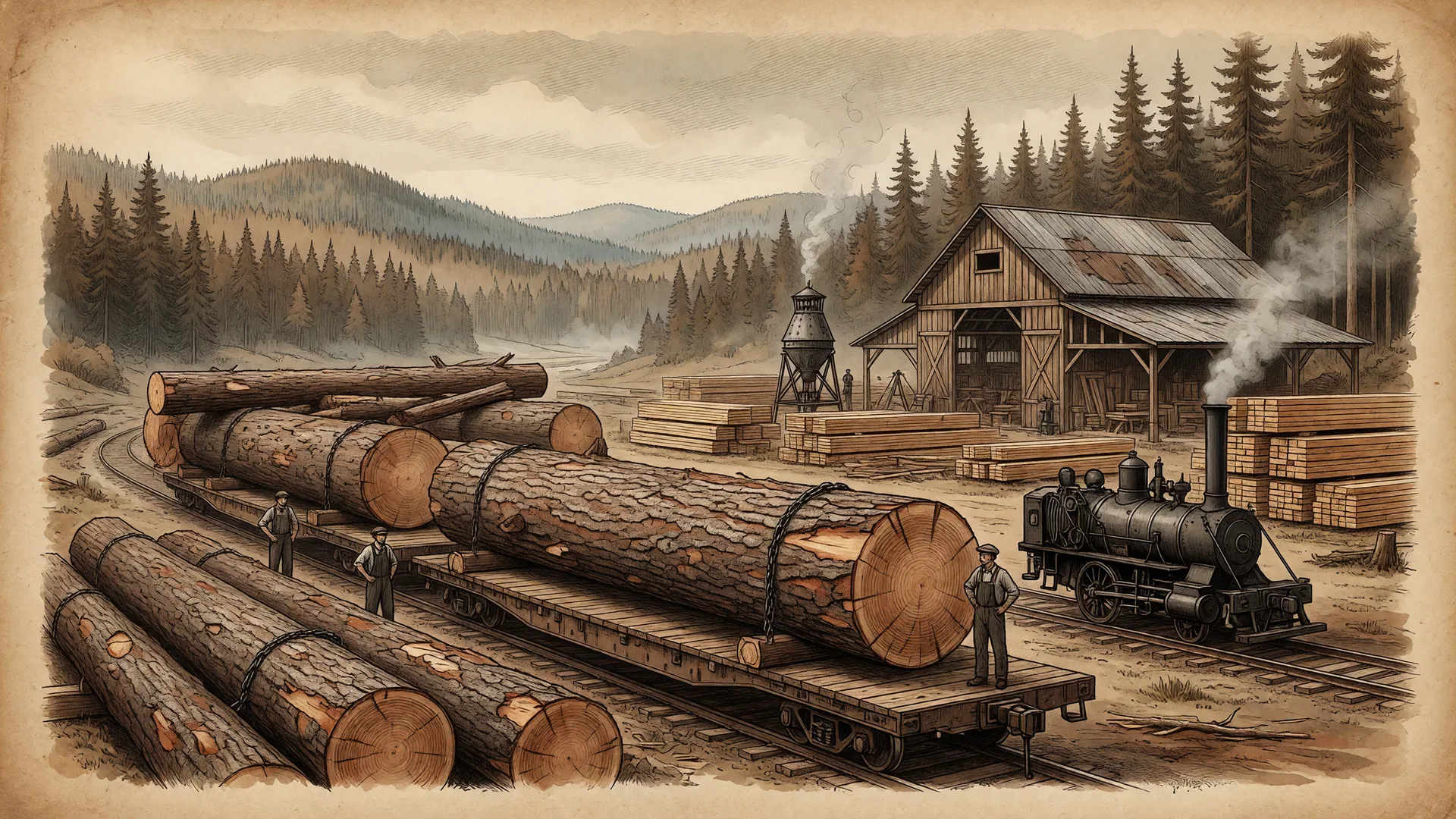
When Timber Helped Build Klamath Falls
Before Klamath Falls became known for its outdoor recreation, lakes, technical education, and distinctive Southern Oregon lifestyle, timber helped define its economy.
The region’s extensive ponderosa pine forests attracted investors and industrial operators who recognized the value of a large, accessible timber resource.
But forests alone do not create a major lumber industry.
Timber must be harvested, transported, milled, sold, and shipped to customers.
That required railroads, industrial investment, workers, equipment, and access to markets.
When those pieces came together in the early twentieth century, Klamath Falls changed dramatically.
Sawmills became major employers. Railroad connections brought new opportunities. Workers and families supported stores, schools, and neighborhoods.
The timber economy helped shape the city’s physical and social landscape.
Understanding its rise—and the changes that eventually reduced its dominance—provides important context for modern Klamath Falls.
Before the Timber Boom
The forests of the Klamath Basin had supported Indigenous communities for generations before industrial lumber companies arrived.
The Klamath, Modoc, and Yahooskin peoples maintained relationships with regional forests, waterways, plants, and wildlife through cultural practices and systems of land stewardship.
The later expansion of commercial timber extraction occurred within a much larger history of colonization, land transfers, federal policy, and changes in resource ownership.
Industrial timber development therefore did not begin with an empty landscape.
It transformed a region that already had communities, knowledge systems, and longstanding relationships with the land.
The Railroad Changes Everything
During the nineteenth century, transportation limited the commercial potential of many inland timber regions.
Logs and finished lumber are heavy.
Without efficient transportation, reaching distant customers can be expensive or impractical.
Railroads changed that calculation.
The arrival of Southern Pacific service to Klamath Falls in 1909 provided an important connection to broader markets.
Later rail improvements further strengthened the city’s position as a regional industrial center.
Railroads made it possible to move large volumes of lumber beyond Southern Oregon.
They also brought equipment, supplies, workers, and investment into the region.
The relationship between railroads and timber was mutually reinforcing: industrial production justified transportation infrastructure, and transportation infrastructure made further industrial growth possible.
The Ponderosa Pine Economy
Ponderosa pine was central to the region’s timber industry.
Its wood could be processed into lumber and a range of manufactured products.
Early industrial uses included box shook, milled pieces used to assemble wooden shipping boxes for agricultural products.
This connected Klamath’s forests to fruit-growing and agricultural markets beyond the Basin.
The shoreline around Lake Ewauna became associated with box factories and industrial activity.
The timber economy was therefore not limited to cutting boards for houses.
It supplied packaging, shipping materials, construction products, and other commercial needs.
The diversity of products helped some businesses respond to changing markets.
Weyerhaeuser and the Scale of Industrial Logging
Large timber companies played a major role in the region’s industrial development.
Weyerhaeuser became one of the most recognizable names in Klamath Falls timber history.
An Oregon Historical Society photograph from 1941 documents the company’s Klamath Falls operation and describes its substantial workforce and production.
According to that historical record, the operation employed approximately 1,200 men and produced around 200 million board feet of wood products annually at the time.
These figures describe a particular historical operation and year. They should not be interpreted as the total employment or production of the entire Klamath timber industry.
The scale nevertheless illustrates how important a major mill could be to a community.
A large employer supported not only its own workforce but also transportation, maintenance, retail businesses, services, and families throughout the region.
Historical reference
The People Behind the Mills
Industrial history is often told through company names and production statistics.
But mills operated because people performed difficult and sometimes dangerous work.
Loggers worked in forests using equipment that changed dramatically over the decades.
Truck drivers and railroad crews transported logs and finished products.
Mill employees operated saws, conveyors, drying equipment, and machinery.
Mechanics maintained industrial systems.
Office staff, supervisors, and sales personnel supported production and distribution.
Families organized their lives around shifts, paychecks, seasonal conditions, and the fortunes of employers.
For some households, timber employment offered a path to stability and homeownership.
For others, the work involved injury risks, economic uncertainty, and vulnerability to layoffs or mill closures.
Both experiences belong in the history.
The Great Depression and Klamath’s Mills
The Great Depression reduced demand for many building products.
When construction slowed, lumber producers faced difficult markets.
Yet not every part of the timber industry responded identically.
The Oregon Historical Society documents that Klamath Falls’ Ewauna Box Company continued operating through difficult Depression years with relatively limited cutbacks because its wooden boxes served California fruit growers.
That example demonstrates the importance of product markets.
A company supplying agricultural packaging could experience different conditions from a company dependent primarily on new building construction.
Industrial diversification was not a modern invention. It was already a practical survival strategy during the Depression.
World War II Changes Production
World War II brought new demands for wood products.
Military logistics required crates, packaging, construction materials, and other supplies.
The Oregon Historical Society reports that Weyerhaeuser’s Klamath Falls operations shifted some production toward military needs, including airplane crates and ammunition cartons.
The workforce also changed as men entered military service and women took on jobs in industrial operations.
These changes demonstrate how a local industry became part of a national wartime economy.
The lumber industry was no longer supplying only ordinary commercial customers.
It was helping support a global military effort.
Why Postwar Demand Did Not Save Every Mill
After World War II, the United States experienced enormous housing demand.
Lumber was essential to construction.
It might seem logical that every timber community would have prospered continuously.
But industrial economies rarely work that simply.
The Oregon Historical Society identifies several Klamath Falls mills that closed during the 1940s and 1950s, including Pelican Bay Lumber Company, Lamm Lumber Company, and Shaw-Bertram Lumber Company.
Changing timber supplies, aging operations, costs, competition, business decisions, and technological shifts could all affect individual companies.
The important lesson is that regional employment can change even when demand for an industry’s products remains substantial.
A strong national housing market did not guarantee the continued operation of every local mill.
Technology and Changing Labor Needs
Over time, timber harvesting and processing became increasingly mechanized.
New equipment changed how logs were cut, moved, sorted, and processed.
Improvements in industrial efficiency could allow businesses to produce more with different staffing requirements.
These developments affected workers and communities.
Jobs that had once required large crews could change or disappear.
Different technical skills became more valuable.
Businesses that failed to adapt could struggle.
For communities built around industrial employment, technological change created both opportunities and disruptions.
Forest Management and Environmental Change
The timber industry’s history is also a story about forests.
Large-scale logging altered landscapes and raised questions about sustainable harvest, habitat, watersheds, fire, and long-term resource availability.
Forest-management practices changed as scientific knowledge, regulations, public expectations, and economic conditions evolved.
In Southern Oregon, these issues remain especially important because forests serve many purposes.
They provide wildlife habitat, influence water systems, store carbon, support recreation, and supply wood products.
They are also affected by drought, insects, disease, wildfire, and changing climate conditions.
Responsible forest management must consider ecological and economic objectives together, even when those objectives create difficult tradeoffs.
The Human Cost of Industrial Decline
When a major employer reduces operations or closes, the consequences reach beyond its workers.
Households may lose income.
Businesses can lose customers.
Property owners may struggle with financial obligations.
Young adults may leave in search of employment.
Local governments may face changes in revenue and service demands.
The decline of a once-dominant industry can also affect community identity.
People who spent generations working in timber may feel that an important part of local culture has been lost.
Those experiences deserve recognition without romanticizing the difficult working conditions or environmental consequences of earlier industrial practices.
What Remains of the Timber Legacy?
Klamath Falls’ timber heritage remains visible in historical photographs, industrial sites, railroad infrastructure, museum collections, and community memories.
Some businesses and industrial activities continue to connect the region with forest products, although the local economy is no longer defined by timber in the same way it once was.
The city’s development also reflects other sectors, including agriculture, education, healthcare, government, and recreation.
The transition illustrates a broader pattern seen in many Western communities: an economy once dominated by resource extraction gradually becomes more varied.
That process is rarely smooth.
It can take decades and involve difficult decisions about employment, land use, infrastructure, and investment.
How Timber History Influenced Housing and Neighborhoods
Timber employment contributed to residential demand during important periods of Klamath Falls’ development.
Workers and families needed homes within reach of mills, transportation routes, schools, and commercial services.
Industrial growth influenced where people lived and how neighborhoods expanded.
Today, older houses may contain construction materials and design features associated with their period, but buyers should not assume a home’s lumber source or connection to a particular mill without documentation.
Historic photographs, property records, building permits, and local archives may help establish more specific relationships.
For modern homebuyers, timber history also provides a reminder that a property’s setting matters.
Homes near former industrial land may warrant research into historical uses, environmental records, and land-use restrictions.
Rural forested properties raise different questions, including wildfire exposure, access, insurance, tree management, and maintenance.
Frequently Asked Questions
Why did Klamath Falls become a timber center?
Extensive ponderosa pine forests, industrial investment, railroad access, and demand for wood products helped establish the city as an important lumber-producing center.
When did the timber industry grow rapidly?
The early twentieth century was a major period of industrial growth, particularly as railroad connections improved and large companies expanded operations.
What did Klamath Falls mills produce?
Products included lumber, wooden shipping-box components, crates, and other processed wood materials.
Why did some Klamath Falls mills close?
Individual mills faced changing business conditions, timber supplies, costs, competition, technology, and other factors. The causes differed by operation and period.
Did World War II affect the local lumber industry?
Yes. Wartime demand influenced production, and some local operations manufactured materials for military logistics. Women also entered industrial positions as wartime labor needs changed.
Is timber still part of Southern Oregon’s economy?
Forest products remain part of the broader regional economy, but Klamath Falls has developed a more diversified economic base than during its peak timber-industrial period.
What should buyers know about property near former industrial sites?
Research historical land uses, available environmental records, zoning, and any applicable restrictions. Qualified environmental professionals may be appropriate for properties with specific concerns.
Continue Exploring
- The Arrival of the Railroad in Klamath Falls (Article 009)
- How the Postwar Years Changed Klamath Falls (Article 018)
- Historic Residential Architecture in Klamath Falls (Article 020)
- How Klamath Falls Neighborhoods Developed (Article 021)
- Rural Property and Acreage Resource Center
- Wildfire and Insurance Guidance for Rural Properties
- Explore Klamath County Communities
Explore homes for sale in Klamath Falls
Ready to see what today's market offers? Lincoln Home provides live access to current MLS listings across Klamath Falls, Klamath County and Southern Oregon, plus personalized search assistance from a local team.
Availability changes as homes sell and new properties come to market, so search filters and results reflect the live listing feed rather than a fixed inventory.
Research and Sources
- Oregon Historical Society — Weyerhaeuser Timber Company
- Oregon Historical Society — Depression and War
- Oregon Historical Society — Transition in the 1950s
- Oregon Encyclopedia — Klamath Falls
- Oregon Historical Society — First National Bank, Klamath Falls
Historical claims in this article trace to the authoritative sources listed above. Illustrations are labeled as such and are not archival photographs; no historic date, designation, quotation or property characteristic is stated beyond what the listed sources support.