
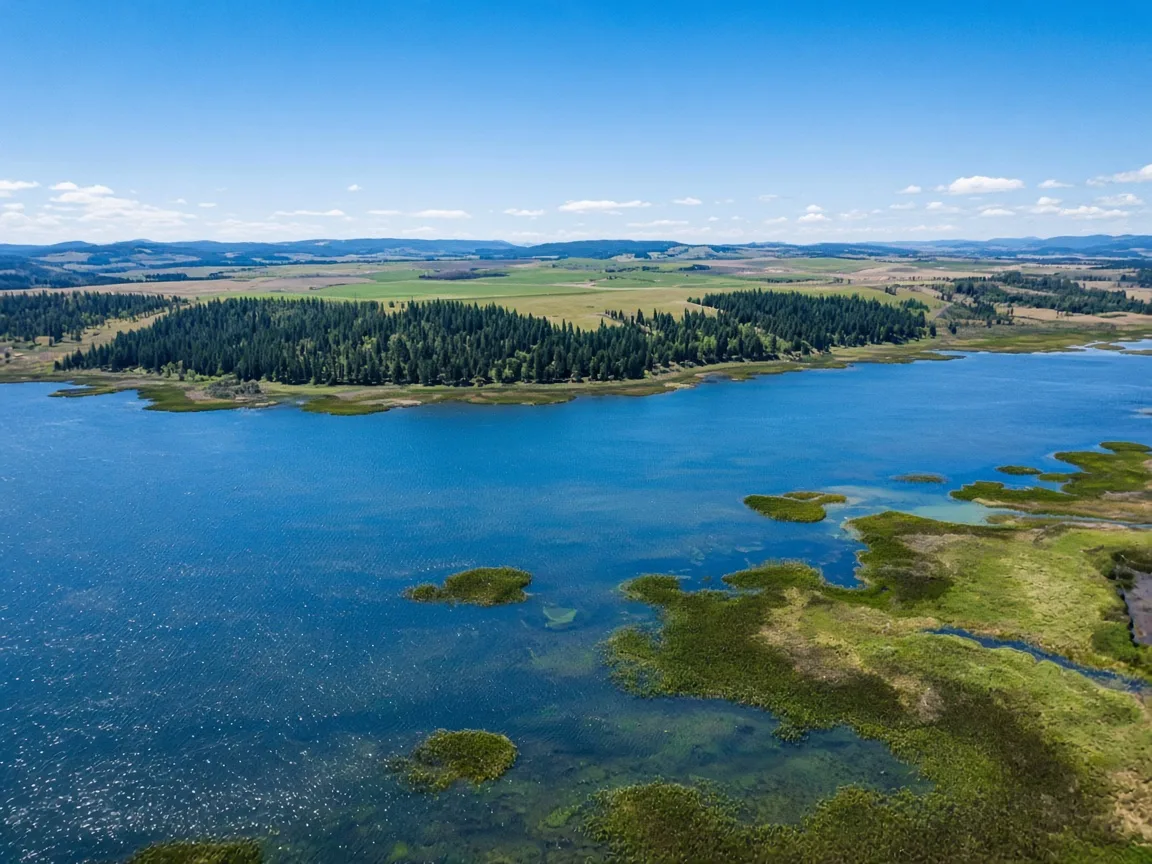
Aerial view of Upper Klamath Lake and its marsh habitat along the northern shoreline.
There is something wonderfully different about experiencing a wetland from the water.
Instead of looking across reeds from a roadside viewpoint, you find yourself at eye level with the marsh.
Bird calls travel over the water. A heron may rise from the vegetation.
The shoreline changes constantly as channels open into wider areas.
Upper Klamath National Wildlife Refuge protects portions of this remarkable environment along Upper Klamath Lake.
A Refuge With Several Distinct Units
Established in 1928, Upper Klamath National Wildlife Refuge includes habitat associated with the northern portion of Upper Klamath Lake and other units, including Hanks Marsh, Barnes Ranch, and Agency Ranch.
The U.S. Fish and Wildlife Service identifies these areas as important habitat for waterbirds, particularly during spring migration.
The refuge's landscape includes freshwater marshes and associated wetland habitat that support a variety of species.
What Makes Marsh Habitat Special?
Marshes are extraordinarily productive ecosystems.
Aquatic plants, insects, small fish, and other organisms form a food web supporting birds and mammals.
Emergent vegetation provides cover and nesting habitat, while open water offers feeding opportunities for other species.
A healthy marsh is not simply a large pond.
Its mixture of water depths, vegetation, seasonal changes, and biological activity creates different habitats within a relatively small area.
Wildlife Viewing From the Water
Where access is authorized and conditions permit, paddling can offer a memorable way to experience the wetland landscape.
However, Upper Klamath Lake is a large body of water, and conditions can change quickly.
Wind, waves, cold water, shallow channels, and navigation challenges require serious preparation.
Check current access rules, boating requirements, weather, and water conditions.
Wear an appropriate personal flotation device and avoid entering restricted habitat.
Never assume that every channel shown on a map is navigable.
Photography Opportunities
Marsh birds can be challenging subjects because vegetation often obscures them.
Instead of approaching a hidden bird, look for open areas where wildlife naturally appears.
Early and late daylight can create beautiful reflections and softer contrast.
A longer lens allows photographers to work without disturbing animals.
A Wetland Connected to a Larger Watershed
Upper Klamath Lake and its surrounding wetlands are part of a complicated watershed involving water quality, fish habitat, agriculture, and communities.
Changes to one part of the system can influence others.
Understanding these relationships helps explain why wetland conservation matters beyond the refuge boundary.
Living Near Upper Klamath Lake
For people who enjoy kayaking, fishing, boating, and birdwatching, proximity to Upper Klamath Lake may be a lifestyle consideration.
Waterfront and lake-area properties also require careful investigation of access, water conditions, insurance, and land-use restrictions.
Frequently Asked Questions
Where is Upper Klamath National Wildlife Refuge?
It protects wetland habitat associated with Upper Klamath Lake in Southern Oregon.
Can visitors kayak there?
Water-based recreation may be available in authorized areas, subject to current refuge rules and conditions.
When is birdwatching especially interesting?
Spring migration is important, although wildlife activity varies throughout the year.
Sources and Further Reading
- Upper Klamath National Wildlife Refuge, U.S. Fish and Wildlife Service
- U.S. Fish and Wildlife Service
- Oregon State Marine Board
Conditions, access, weather, water quality, fees, and regulations can change. Verify current information with the managing agency and the official sources above before traveling.
Related reading
Waterfront and lake-area properties require careful investigation of access, water conditions, insurance, and land-use restrictions. Lincoln Home's buyer resources can help.
Lincoln Home never implies a property offers guaranteed wildlife sightings, hunting access, water rights, development rights, or public-land access. Verify each of these independently for any specific parcel.