
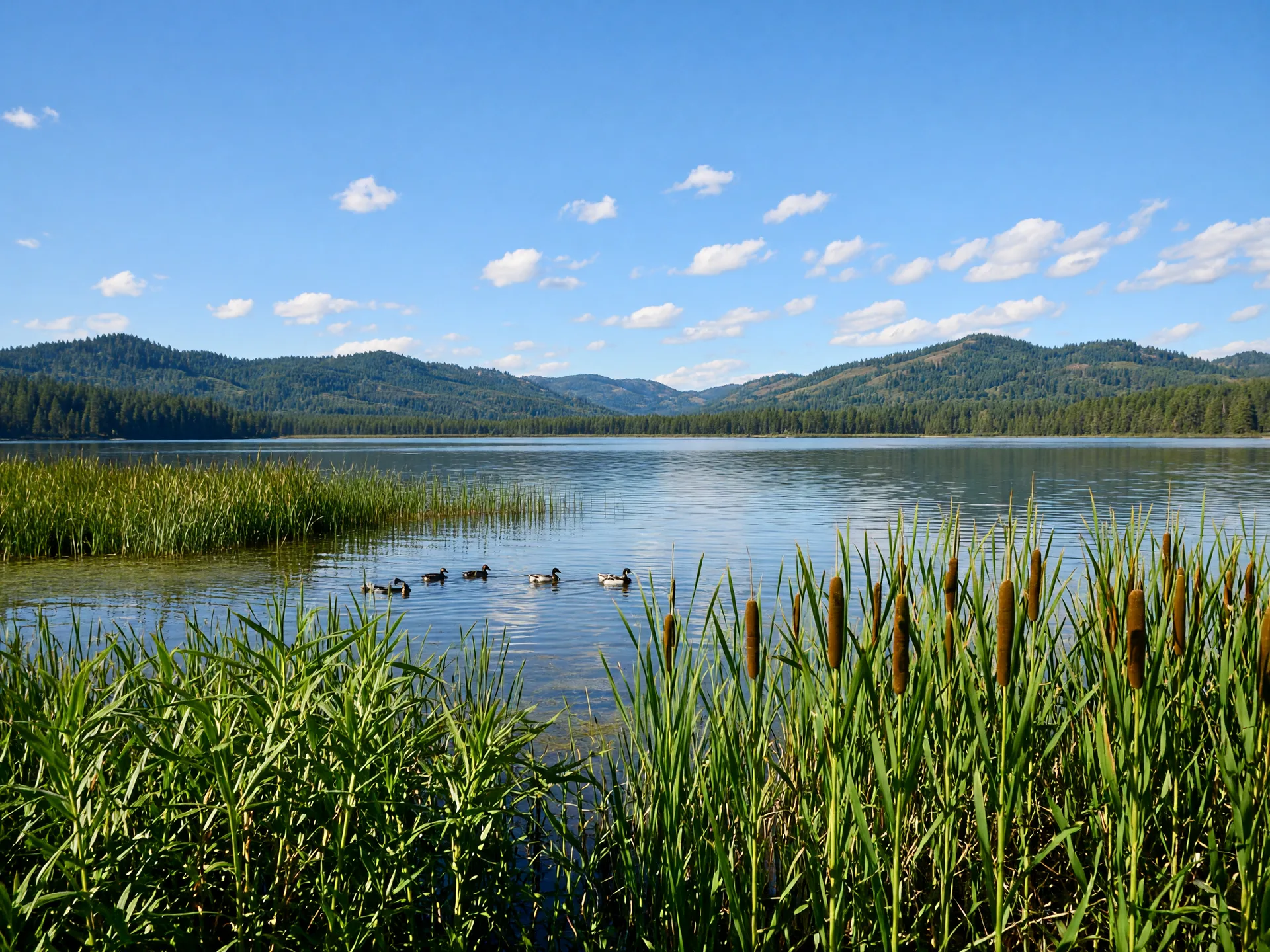
A freshwater marsh and lake in the Klamath Basin, a stopping place along the Pacific Flyway.
Every spring and fall, a remarkable movement takes place above western North America.
Birds travel between breeding areas, wintering grounds, and important feeding locations.
Some journeys cover enormous distances, crossing mountains, deserts, agricultural valleys, and wetlands.
The Pacific Flyway is the broad name given to one of the major migration corridors connecting these habitats.
And the Klamath Basin sits within an especially important part of that network.
Why Migrating Birds Need Stopping Places
Migration requires energy.
Birds cannot simply fly indefinitely without suitable opportunities to rest and replenish their reserves.
Wetlands can provide food, water, shelter, and relatively safe places to pause during a journey.
The Klamath Basin's historical wetland system made it particularly valuable to waterfowl and other migratory birds.
The U.S. Fish and Wildlife Service identifies the refuge complex as an important surviving portion of a once much larger wetland landscape.
What Birds Use the Pacific Flyway?
The flyway supports numerous species, including ducks, geese, swans, shorebirds, cranes, and other migratory birds.
Different species follow different schedules.
Some travel relatively short distances, while others undertake extraordinary migrations spanning much of the continent.
Not every bird follows the same route or uses the same habitat.
Shallow water may benefit one species, while deeper open water, mudflats, or nearby agricultural fields are more useful to another.
That variety makes habitat management complicated.
The Water Challenge
Wetlands need water, but the Klamath Basin's water supplies are subject to competing demands and environmental variability.
Agriculture, communities, fish, wildlife, and Tribal interests all have important relationships with the basin's water resources.
Drought and changes in water management can reduce available wetland habitat, affecting the birds that depend on it.
A wetland shown on a map is not necessarily full of water when a visitor arrives.
Conservation and Working Landscapes
One interesting approach involves seasonal wetland management on agricultural land.
The Lower Klamath refuge describes walking wetlands, in which certain fields rotate between agricultural production and wetland conditions.
This approach recognizes that habitat management and agricultural productivity can sometimes be integrated rather than treated as completely separate objectives.
It doesn't resolve every water dispute, but it demonstrates the value of practical cooperation.
What Visitors Can Do
Support responsible refuge access, observe wildlife without disturbance, and learn about the environmental challenges affecting the basin.
A visit becomes more meaningful when you understand that the birds you're watching may depend on several habitats separated by hundreds or thousands of miles.
The marsh in front of you is part of a much larger system.
Conservation and Community Life
Healthy wetlands and open landscapes are part of the natural character that attracts people to Southern Oregon.
Buyers considering land near sensitive habitat should investigate development restrictions and environmental conditions.
Frequently Asked Questions
What is the Pacific Flyway?
It is a major migratory route used by birds traveling through western North America.
Why is the Klamath Basin important?
Its wetlands provide habitat and feeding opportunities for migrating and resident birds.
Does drought affect bird migration?
Drought can reduce suitable wetland habitat and change where birds are able to stop and feed.
Sources and Further Reading
Conditions, access, weather, water quality, fees, and regulations can change. Verify current information with the managing agency and the official sources above before traveling.
Related reading
Buyers considering land near sensitive habitat should investigate development restrictions and environmental conditions. Lincoln Home's rural-property resources can help.
Lincoln Home never implies a property offers guaranteed wildlife sightings, hunting access, water rights, development rights, or public-land access. Verify each of these independently for any specific parcel.