
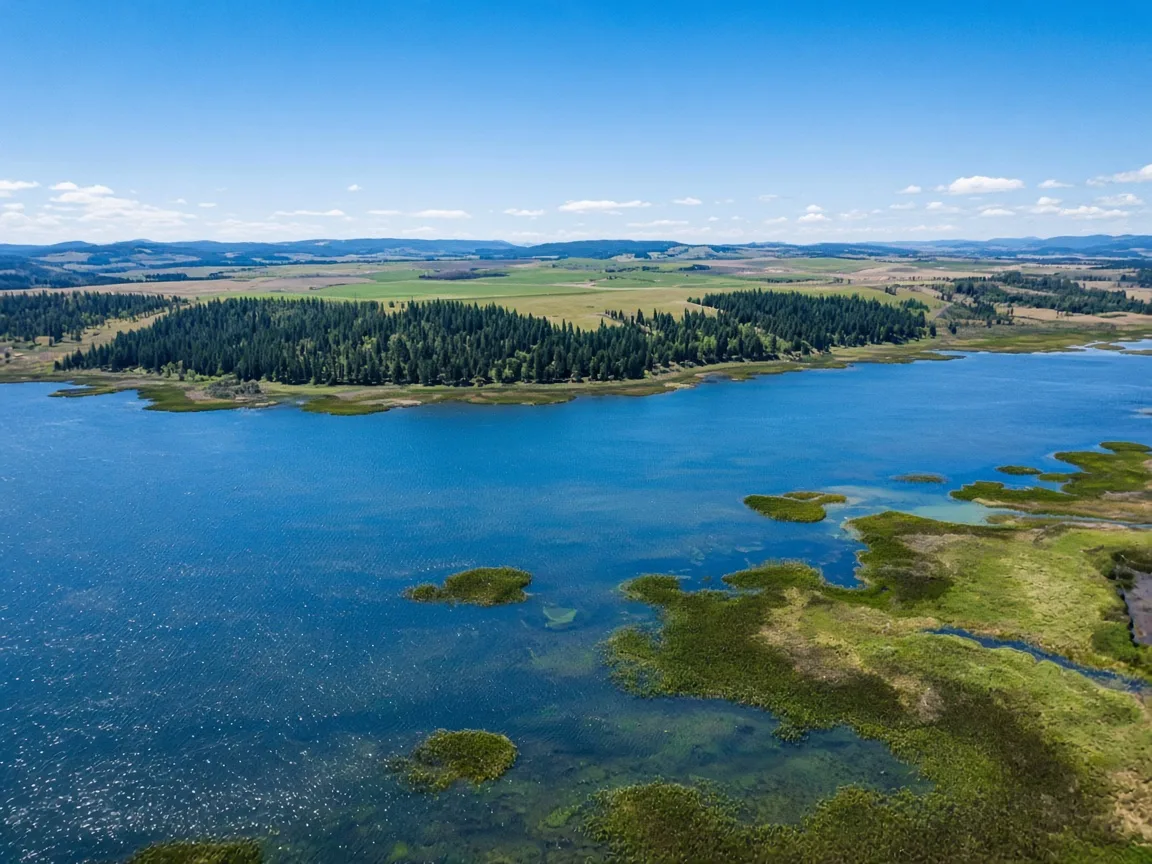
The Lake That Defines a Region
There are lakes you visit for a weekend, and then there are lakes that help define an entire region.
Upper Klamath Lake belongs firmly in the second category.
Stretching north from Klamath Falls toward the surrounding valleys and mountains, the lake is one of the most important natural features in Southern Oregon. It influences local wildlife, water management, agriculture, recreation and the geography of communities throughout the Upper Klamath Basin.
For someone seeing it for the first time, the scale can be surprising. The lake seems to spread across the landscape rather than occupy a narrow mountain valley. Its shallow waters reflect broad skies, while wetlands and distant volcanic peaks create a setting unlike the deep alpine lakes for which Oregon is also famous.
But Upper Klamath Lake is more than scenery.
It is a living ecosystem with a geological history stretching back thousands of years, a deep cultural relationship with Indigenous peoples, and an important role in the continuing story of water in the American West.
Oregon's Largest Freshwater Lake by Surface Area
Upper Klamath Lake is Oregon's largest freshwater lake by surface area.
Depending on water levels, it covers roughly 60,000 acres and extends approximately 25 miles from north to south.
Despite its enormous surface area, the lake is relatively shallow. Its average depth is generally around eight feet, although depths and water levels vary.
This creates an interesting contrast with Crater Lake, located in the Cascade Mountains northwest of Klamath Falls.
Crater Lake occupies a deep volcanic caldera and reaches approximately 1,943 feet at its deepest point.
Upper Klamath Lake, by comparison, spreads across a broad geological basin.
These two lakes demonstrate how dramatically different bodies of water can be, even within the same region.
How Did Upper Klamath Lake Form?
The lake's origins are connected with the geological history of the Klamath Basin.
Faulting and volcanic activity helped shape the surrounding landscape, creating elevated terrain and lower areas where water could accumulate.
Over long periods, sediments collected within the basin.
Changing climate conditions influenced lake levels and the extent of surrounding wetlands.
The lake visible today is part of a much longer history of freshwater environments occupying the region.
Its shallow depth and extensive shoreline reflect that geological setting.
Where Does the Water Come From?
Upper Klamath Lake receives water from a network of rivers, springs, groundwater systems and smaller tributaries.
The Williamson River is one of its major inflows.
The Sprague River joins the Williamson near Chiloquin, connecting a large watershed east of the lake to the larger system.
The Wood River contributes water through Agency Lake, which connects with Upper Klamath Lake.
Water leaving the lake flows through the Link River toward Lake Ewauna and continues into the Klamath River.
Eventually, that water travels through Northern California to the Pacific Ocean.
This means Upper Klamath Lake is not an isolated destination.
It is part of an interconnected watershed extending across two states.
The Lake's Indigenous History
Long before Klamath Falls developed as a modern city, the lake and surrounding wetlands were essential to Indigenous communities.
The Klamath Tribes maintain longstanding cultural relationships with the region's waters, fish, plants and wildlife.
The lake supported traditional food systems and activities connected with seasonal changes.
Wetland plants, fish and waterfowl were important resources.
These relationships are not simply historical footnotes. They remain part of the cultural identity of the region.
Understanding Upper Klamath Lake requires recognizing that its human history extends far beyond modern settlement and agricultural development.
Why Is the Water Sometimes Green?
One of the most common questions visitors ask concerns the lake's appearance.
Unlike Crater Lake, Upper Klamath Lake is naturally nutrient-rich and relatively shallow.
During warmer periods, cyanobacterial blooms can affect water color and water quality.
These blooms are influenced by nutrients, sunlight, temperature and other environmental conditions.
The lake's ecology is complicated because its biological processes are affected by both natural characteristics and changes associated with human activity.
Water-quality concerns can influence recreation and aquatic habitat.
Visitors should check current advisories before swimming or allowing pets into lake water.
Native Fish and Conservation
Upper Klamath Lake supports important native fish populations.
Among the best known are the Lost River sucker and shortnose sucker, both of which have been the focus of conservation efforts.
These fish are closely connected with the lake and its tributaries.
Their survival depends on suitable water quality, habitat and access to appropriate environments during different life stages.
The lake also supports other aquatic organisms and wildlife.
Its ecological importance extends well beyond the species most visitors recognize.
Wetlands Around the Lake
Historically, extensive wetlands surrounded Upper Klamath Lake.
These marshes supported fish, birds, insects and aquatic vegetation.
During the twentieth century, portions of the wetlands were diked or drained for agricultural development.
More recently, restoration projects have sought to recover some wetland functions.
Wetlands can help slow water movement, support habitat and influence nutrient cycling.
Their relationship with the lake is an important part of modern conservation research.
Recreation and Scenic Beauty
Upper Klamath Lake offers opportunities for boating, wildlife observation, photography and other outdoor activities.
Its broad waters and surrounding landscape can be spectacular, particularly when the Cascades are visible in the distance.
Conditions can change quickly on a large, shallow lake.
Wind may produce challenging boating conditions.
Water quality and seasonal access should also be considered.
Residents and visitors should plan activities according to current conditions.
What Is It Like to Live Near Upper Klamath Lake?
For homebuyers, lake-area property can be attractive.
Views across the water and wetlands can be extraordinary.
The surrounding landscape provides a sense of openness that differs from more densely developed communities.
But lake-area real estate requires careful investigation.
Buyers should verify legal access, property boundaries, flood considerations, wetlands, septic feasibility and any applicable development restrictions.
A lake view does not automatically mean lake access.
A property near water may have responsibilities that are not obvious from photographs.
Why Upper Klamath Lake Matters
Upper Klamath Lake is one of the defining features of Klamath County.
Its history connects geology, Indigenous communities, agriculture, wildlife and modern water management.
Its waters link the surrounding rivers to the larger Klamath watershed.
And its landscape contributes to the distinctive character of Klamath Falls.
For residents, understanding the lake means understanding an essential part of the place they call home.
Frequently Asked Questions
Is Upper Klamath Lake the largest lake in Oregon?
It is Oregon's largest freshwater lake by surface area.
How deep is Upper Klamath Lake?
It is relatively shallow, with an average depth generally around eight feet.
Why does Upper Klamath Lake sometimes look green?
Its nutrient-rich waters can experience seasonal cyanobacterial blooms.
What rivers feed Upper Klamath Lake?
Major sources include the Williamson River and the Wood River system, along with other tributaries and groundwater.
Does Upper Klamath Lake connect to the Klamath River?
Yes. Water leaves through the Link River and continues into the Klamath River system.
Can you buy lakefront property near Klamath Falls?
Yes, but buyers should verify actual water frontage, legal access, flood considerations and development requirements.
Continue Exploring
Read Article 082 on Agency Lake, Article 086 on the Williamson River and Article 093 on Klamath Basin wetlands.
Explore Lincoln Home's Waterfront Property, Klamath Falls Communities and Rural Buying Guides.
Sources and Further Reading
The linked references are editorial starting points. Lincoln Home verifies source availability and relevance before publication.