
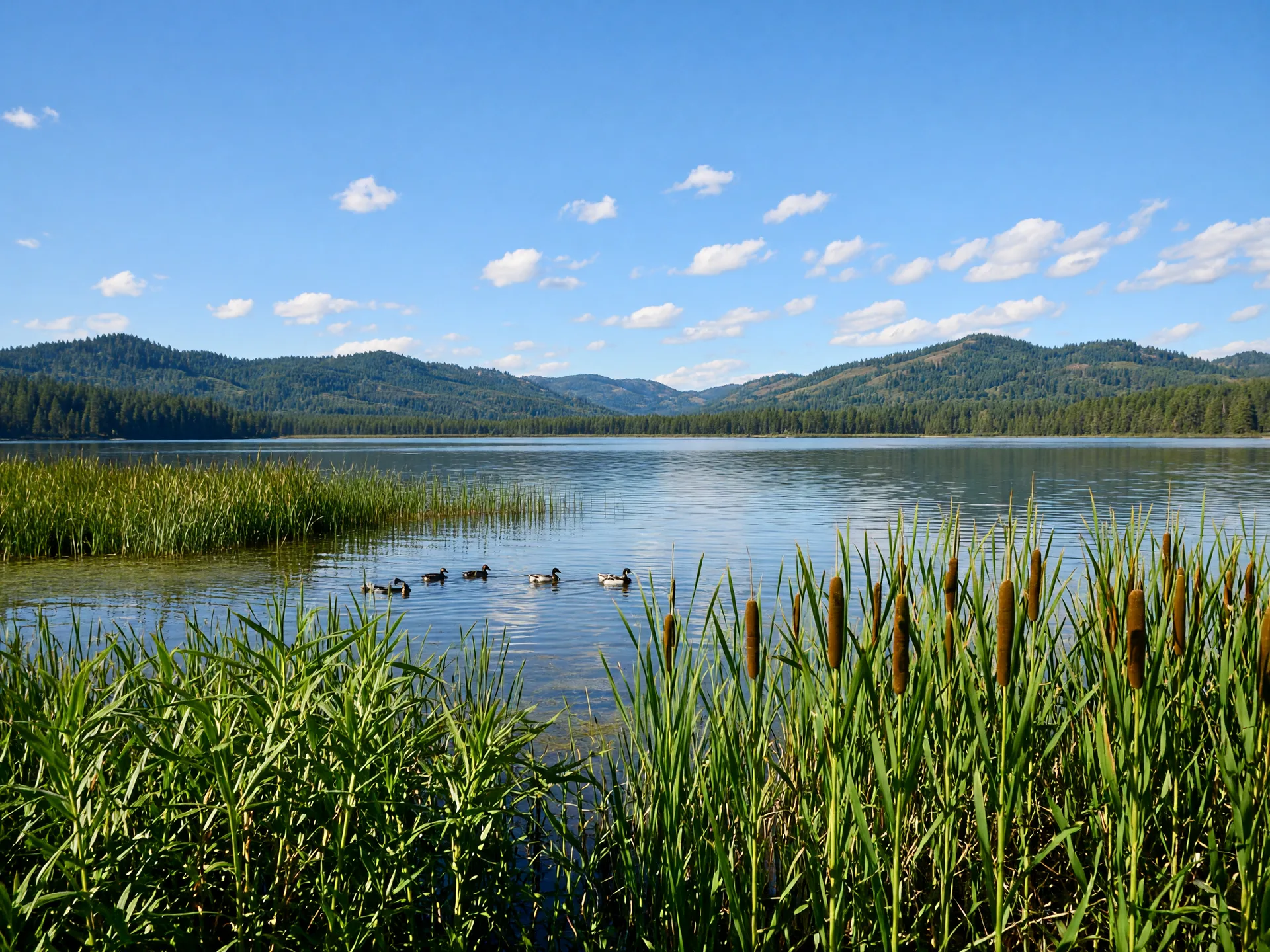
A freshwater marsh and lake shoreline, illustrating the kind of natural boundary waterfront buyers investigate.
Buying waterfront property can involve legal questions that rarely arise with an ordinary residential lot.
Where does the property boundary end? Can the public use the water? Does the owner have a right to build a dock? Can water be withdrawn for irrigation?
These questions may involve different laws, agencies and recorded rights.
Understanding the distinctions is essential before purchasing.

Land Ownership and Water Rights Are Different
Owning land beside a lake does not automatically grant unrestricted rights to use the water.
Oregon regulates many water uses through its water-rights system.
Depending on the proposed use, a water right or another legal authorization may be required.
Buyers should not assume that an existing pump, irrigation pipe or water feature establishes a valid right.
The Oregon Water Resources Department is an important source of information.
Visit https://www.oregon.gov/owrd/.
Property Boundaries Near Water
Waterfront boundaries can be complicated.
Legal descriptions, surveys, historical records and the legal status of the waterbody may affect the analysis.
A fence, dock or apparent shoreline is not necessarily the legal property boundary.
Qualified surveyors and attorneys may be needed to resolve uncertainty.
Navigable Waters and Public Rights
Oregon recognizes public rights involving certain waterways, but the details depend on the legal status of the waterbody and the activity.
Public rights to use water do not automatically authorize crossing private upland property.
Similarly, private shoreline ownership does not necessarily confer exclusive control over every activity occurring on the water.
These questions should be evaluated individually.
Easements and Shared Access
A recorded easement may allow specific access across another parcel.
The easement's purpose, location, permitted uses and maintenance responsibilities matter.
Buyers should obtain the recorded documents rather than relying on verbal explanations.
Docks, Shoreline Work and Permits
Installing or modifying a dock, dredging, filling wetlands or altering a shoreline may involve state, federal and local authorizations.
Depending on the project, relevant agencies may include the Oregon Department of State Lands, U.S. Army Corps of Engineers and local planning authorities.
Never begin shoreline work based solely on the assumption that the property owner controls the area.
Wetlands and Environmental Protections
Waterfront properties may contain wetlands or protected habitat.
These conditions can limit development or require additional permitting.
A property with several acres of land may not have several acres suitable for construction.
Environmental due diligence should occur before committing to a particular development plan.
Floodplain Considerations
Floodplain regulations may affect construction, remodeling and insurance.
Review available FEMA information and local development requirements.
A property outside a mapped high-risk flood zone can still experience flooding.
Questions to Ask Before Buying
What rights are documented in the deed and title materials?
Are there recorded easements or shared-access agreements?
Are docks and shoreline structures permitted?
Are wetlands present?
Are water rights being represented as part of the transaction?
What agencies regulate the intended use?
Answers should be supported by records and qualified professional review.
Protect Your Investment Before You Purchase
Waterfront real estate can offer an exceptional lifestyle, but buyers should understand the rights they are actually acquiring.
Explore Southern Oregon waterfront and recreational properties through Lincoln Home at https://klamathproperty.com/.
Conditions change. Verify lake information before you go.
Lake conditions, access, weather, water quality, fees, and regulations can change at any time. Verify current information with the managing agency and the official sources on this page before traveling. Never assume that a lake suitable for one activity is suitable for another.
Frequently Asked Questions
Does owning lakefront land mean owning the lake?
No. Ownership and public-use rights depend on the particular waterbody and applicable law.
Can I use lake water to irrigate my property?
Do not assume so. Investigate applicable water rights and exemptions.
Can I build a private dock?
Possibly, but property rights, permits and agency restrictions must be reviewed.
Who can determine my exact waterfront boundary?
A qualified surveyor, with legal assistance when necessary, can help investigate boundary questions.
Sources and Further Reading
- Oregon Water Resources Department
- Oregon Department of State Lands
- FEMA
- U.S. Army Corps of Engineers
Conditions, access, weather, water quality, fees, and regulations can change. Verify current information with the managing agency and the official sources above before traveling. On water-quality pages, the current Oregon Health Authority advisory page is the reference for harmful algal bloom status.
Related reading
Explore Southern Oregon waterfront and recreational properties through Lincoln Home at https://klamathproperty.com/.