
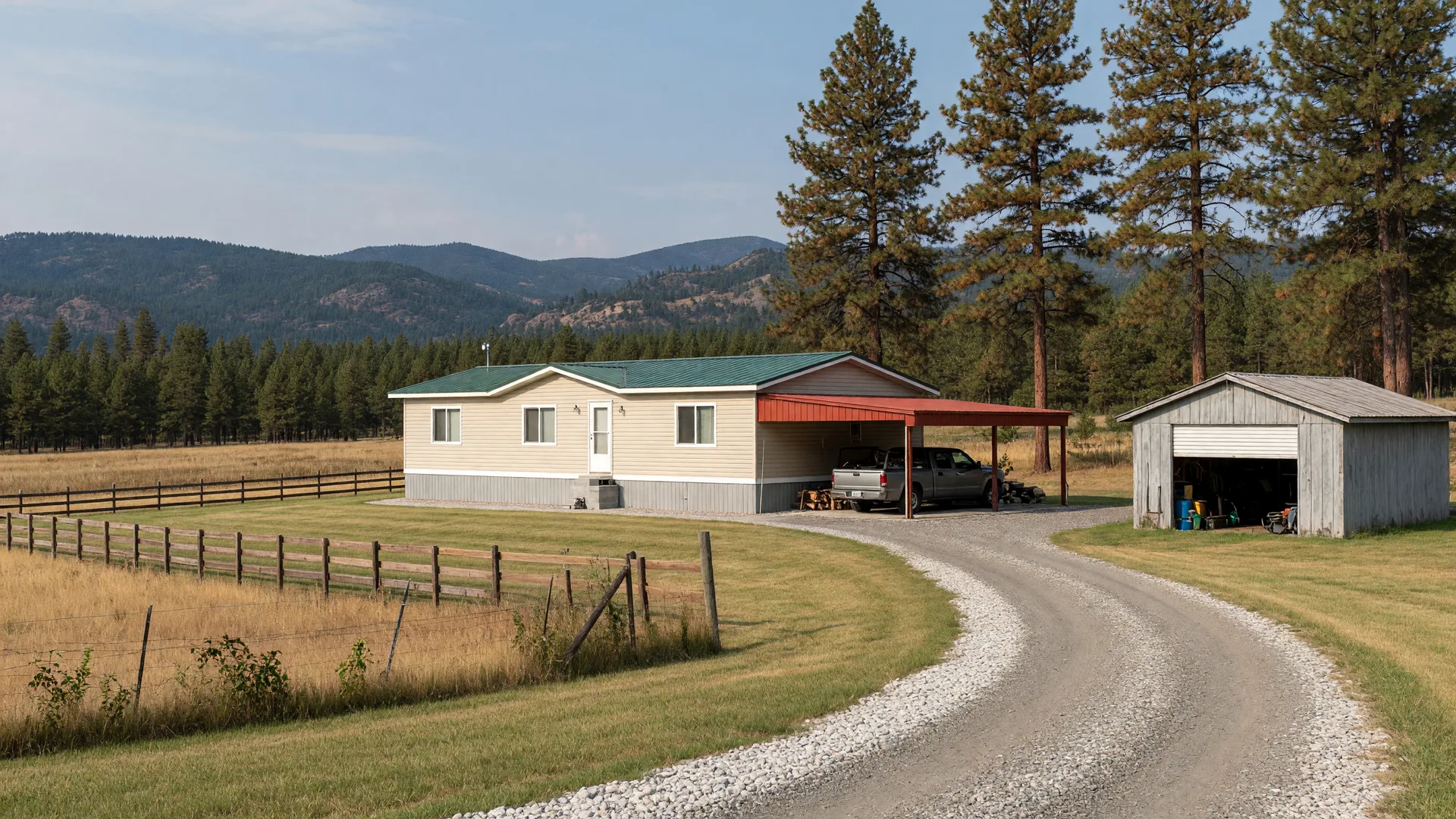
Manufactured Homes Are an Important Part of Rural Housing
Throughout Southern Oregon, manufactured homes provide housing on everything from modest residential lots to substantial rural acreage.
Some are newer homes with contemporary floor plans and modern amenities.
Others are older homes that have been expanded, remodeled, or placed on properties with workshops, barns, and other improvements.
For buyers, manufactured homes can create opportunities to own land and a residence at different price points.
But they also require careful investigation of ownership documentation, installation, financing, and legal classification.
What Is a Manufactured Home?
A manufactured home is constructed in a factory under applicable federal manufactured-housing standards and transported to its installation site.
It is different from a site-built home and should not automatically be confused with a modular home, recreational vehicle, or older mobile home.
Construction standards, installation requirements, and financing eligibility can differ among these categories.
Understanding Personal Property
A manufactured home may be documented separately from the underlying land.
In that situation, the home and the real estate can involve different ownership records and security interests.
This can create additional considerations during a sale.
For example, a buyer might be purchasing the land through a recorded deed while the manufactured home requires separate ownership-document procedures.
A thorough transaction should verify that the seller has the authority to transfer the relevant interests and that any liens are appropriately addressed.
When Does a Manufactured Home Become Real Property?
Oregon provides a process for qualifying manufactured homes to be recorded as real property.
This is a legal documentation and recording process, not simply a physical construction decision.
The Oregon Building Codes Division administers manufactured-home ownership documentation through its Manufactured Home Ownership Document System.
The process can involve an application, supporting information, and recording with the appropriate county office.
The exact requirements depend on the circumstances and applicable law.
Buyers and sellers should confirm the current process with Oregon's Building Codes Division, the county recording office, and qualified title or legal professionals.
Does a Permanent Foundation Automatically Convert the Home?
No.
A permanent foundation can be important for installation and financing, but physical attachment alone does not establish that the manufactured home's legal ownership status has been properly converted.
The documentation must also be correct.
Conversely, the existence of a recorded document should not be treated as proof that every installation or foundation requirement has been satisfied.
These are related but distinct questions.
Why This Matters for Financing
Mortgage lenders evaluate manufactured homes according to their loan programs and underwriting requirements.
Relevant considerations may include the home's age, construction standards, foundation, ownership documentation, land ownership, condition, and appraisal.
A manufactured home may qualify for certain real-estate mortgage products when applicable requirements are satisfied.
Other situations may involve different financing arrangements.
Never assume that all manufactured homes qualify for conventional, FHA, VA, or other loan products.
A lender familiar with manufactured housing can explain the requirements for a specific transaction.
Manufactured Homes Built Before June 15, 1976
The federal manufactured-home construction and safety standards became effective on June 15, 1976.
Older mobile homes may present additional financing, insurance, and compliance challenges.
Buyers should confirm the home's construction date and relevant identification information rather than relying solely on a listing description.
Verify the Home's Identity
Manufactured homes may have identifying information associated with their construction and ownership records.
Buyers should investigate available serial numbers, labels, data plates, and official ownership documentation as appropriate.
Discrepancies between records and the physical home may require resolution before closing.
What About Additions?
A manufactured home may have a garage, enclosed porch, attached room, deck, or roof structure.
These additions deserve separate investigation.
An improperly designed addition can place unintended loads on the home or create water intrusion, structural, or safety concerns.
Ask for available permits and consider specialized inspections.
Manufactured Homes on Leased Land
Some manufactured homes are located in parks or communities where the homeowner owns the structure but leases the underlying space.
That arrangement differs significantly from owning a manufactured home and the land beneath it.
Review lease terms, community rules, fees, and transfer requirements before purchasing.
For rural acreage buyers, verify whether the transaction includes fee ownership of the land.
Property Taxes and Assessment
Manufactured-home classification and recording can affect how ownership and assessment records are maintained.
Buyers should review county assessment information and consult appropriate professionals about the property's actual tax treatment.
Do not assume that a home is assessed in a particular way solely because it sits on a foundation.
Insurance Considerations
Insurance availability and coverage depend on the home, installation, condition, location, and insurer.
Ask whether the policy covers the home, attached improvements, detached structures, personal property, and liability.
Older homes and properties with unusual additions may require additional attention.
Selling a Manufactured Home on Acreage
Sellers should organize ownership documentation early.
Review available installation permits, foundation information, improvement records, and any existing security interests.
Correcting documentation issues before listing may reduce delays during escrow.
Accurate marketing should distinguish between the home, land, outbuildings, and any special features.
Educational comparison
Personal-Property Documentation vs. Real-Property Recording
These two situations are documented and transferred differently. The category that applies to a particular manufactured home depends on its ownership documents and recording history.
Documented as personal property
- The home is documented separately from the land it sits on.
- Ownership transfers through the home's ownership documents, not through the deed alone.
- Security interests and liens on the home are handled separately from the real estate.
- The home does not appear in the county real-property records.
Recorded as real property
- The manufactured home is recorded with the county as part of the real property.
- Ownership transfers with the deed and the real property through the recording process.
- Title to the home and the land is examined together in the transaction.
- Oregon's Building Codes Division ownership-document system and the county recording process apply.
This comparison is educational. Whether a specific home is documented as personal property or recorded as real property depends on its ownership documents, installation history, and the applicable legal process. Verify every home with Oregon's Building Codes Division, the county recording office, and qualified title or legal professionals. A permanent foundation by itself does not establish that a manufactured home has been legally recorded as real property.
Frequently Asked Questions
Can a manufactured home become real property in Oregon?
Yes, when the applicable legal requirements and recording procedures are satisfied.
Is a manufactured home automatically real property if I own the land?
No. Land ownership alone does not establish completion of the required manufactured-home recording process.
Can I get a conventional mortgage on a manufactured home?
Potentially, depending on the lender, loan program, and property eligibility.
Does a concrete foundation guarantee mortgage approval?
No. Financing eligibility involves multiple requirements beyond the foundation.
Can I move a manufactured home after it has been recorded as real property?
Relocation can involve additional legal, ownership-document, permit, and installation requirements. Verify the applicable procedures before making plans.
Explore Manufactured Homes and Acreage in Klamath County
Lincoln Home can help buyers explore manufactured homes while encouraging appropriate review of title, financing, and property condition.
Search note: the Lincoln Home property search portal covers active Klamath Basin MLS listings across the whole region. It does not offer separate filters for outbuildings, manufactured-home classification, or per-community rural searches. Use the broad search to browse current inventory, then ask Lincoln Home for a saved search targeted to your area and criteria.
More From the Rural Living & Acreage Series
The Rural Living & Acreage series walks through zoning, building, outbuildings, access, and lifestyle. Start with the guides below.
- Rural Zoning and Land Use in Klamath County: What Buyers Need to Know What a parcel's zoning actually allows before you plan a home.
- Building a Home on Vacant Land in Klamath County The construction path from property search to move-in.
- Buying Property With a Barn, Shop, or Outbuildings in Klamath County What to inspect and verify when improvements include more than the house.
- Rural Property & Acreage Guides The full collection of rural property guides from Lincoln Home.
Official Resources and Further Reading
- Oregon Building Codes Division: Manufactured Home Ownership
- Oregon Building Codes Division: Manufactured Home Ownership Forms
These official resources are the starting point for verifying rules for a specific property. Lincoln Home presents general educational content, not property-specific legal approval. Confirm current requirements with the responsible agency before relying on any development claim.